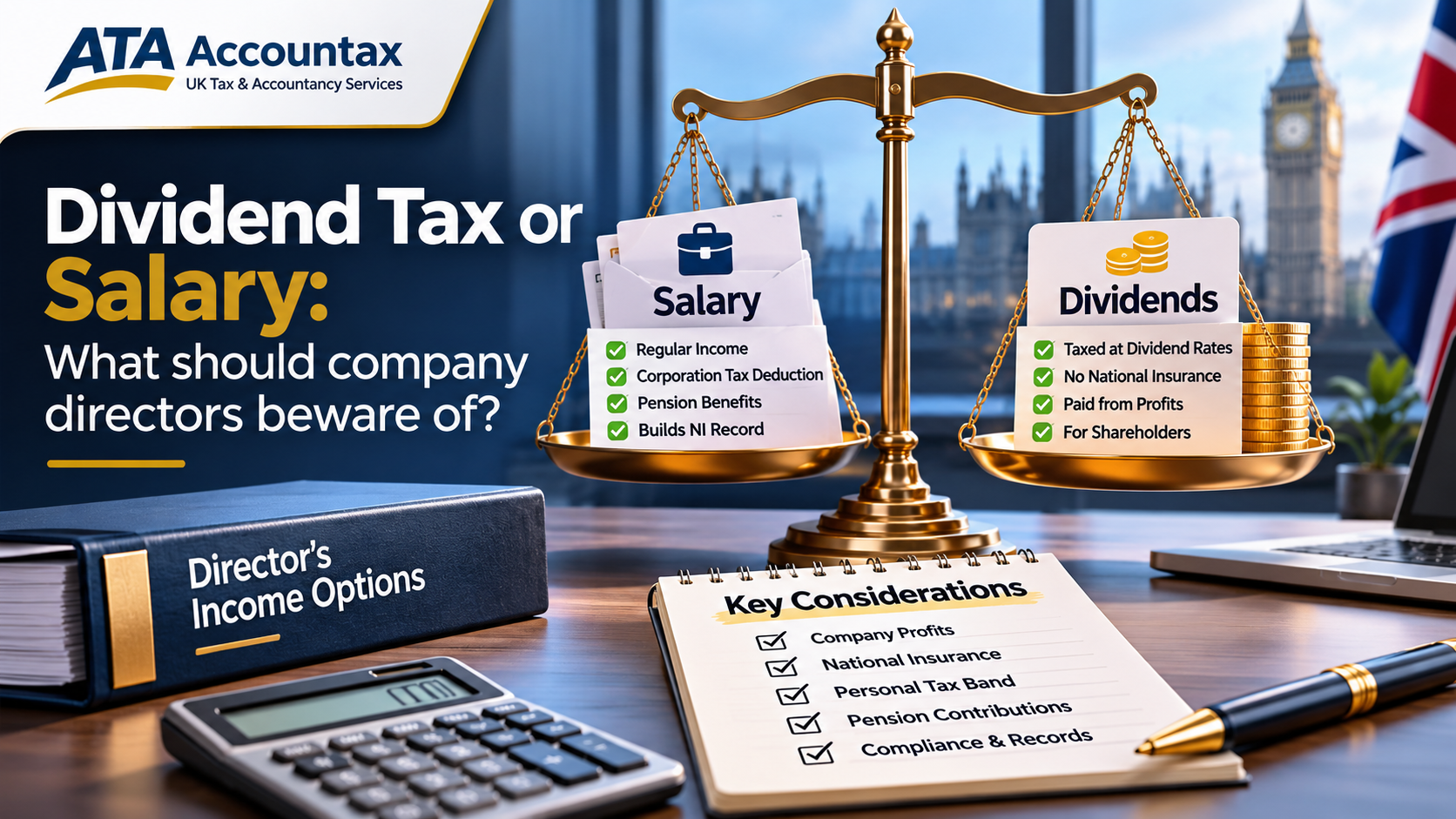
Dividend Tax or Salary: what should company directors beware of?
As the director of a limited company, the big question is: how do I withdraw money?
There are two options available to most Company Directors in the UK, these are; taking a salary or drawing dividends. Both of these allow you to earn income through your company but are subject to different tax considerations.
Selecting the best one could impact your tax bill or the amount of money you receive. And it’s a question of whether to choose the one with the lowest tax rate. Your company’s profit, your National Insurance payments, and your personal circumstances should also be taken into account.
How pay and dividends work, and what directors need to take into account before choosing between them.
What Is a Director’s Salary?
Salary is a fixed amount paid by the company to its director for his/her work.
Directors are also employees of the company and if so they can be paid through the payroll. Income Tax and National Insurance contributions may then be deducted from the directors salary.
An important note is that salary is generally regarded as a business expense. This means the business is able to normally include it when working out its taxable profits for Corporation Tax, assuming the pay is made in accordance with the relevant tax rules.
But they should do PAYE properly and account for any employer’s National Insurance.
What Are Dividends?
Payments made to shareholders from a company’s accumulated earnings are known as dividends.
Dividends aren’t payments to work in the business – unlike a salary. They are an income distribution to shareholders of the company.
Even when directors have invested in their limited company, this investment may not be taxed when they receive a salary from their company. For example, directors who have invested in their limited company may also get paid in dividends.
Here are a few simple rules to keep in mind:
- Dividends must be paid out of profits available for that purpose.
- They are paid following the deduction of Corporation Tax.
- Not allowed as a business expense for Corporation Tax.
- Dividend policy decisions and payments should be well documented.
This doesn’t mean a director is entitled to get dividends by virtue of them conducting the company’s business. They will also need to be a shareholder who is entitled to the dividends.
Salary and Dividends: What is the Difference?
While both options give directors cash, it’s taxed differently.
| Factor | Salary | Dividends |
|---|---|---|
| Payment type | Payment for work | Share of company profits |
| Income Tax | Yes, where it applies | Yes, when over and above the available allowances |
| National Insurance | may be liable for employee and employer NI | No National Insurance |
| Corporation tax | Deductible as a trade expense | Not deductible |
| Conditions of payment | By payroll | From the available profits |
| Pension contributions | Relevant employment earnings | not relevant earnings |
The primary distinction is that salary can decrease the company’s taxable profits, while dividends are paid from profits after Corporation Tax.
How Is Salary Taxed in the UK?
The salary of a director is taxed in the normal way as employment income.
The basic Personal Allowance for 2026/27 is £12,570. You don’t pay Income Tax on an amount of income that’s the same as your Personal Allowance (if you’re eligible) – but there are rules about this.
Main Income Tax bands for England, Wales and NI are:
- Standard rate: 20%
- Higher rate: 40%
- Further rate: 45%
The directors may have to pay employee National Insurance and, the company may owe employer National Insurance.
It varies according to your director’s salary, and circumstances.
Alternatively, it’s worth noting that there are special rules for directors when it comes to their National Insurance calculations – which often depend on the director’s ‘yearly pay’ rather than every individual pay period.
How Is Dividend Income Taxed?
Dividends have their own types of tax and are dealt with separately from salary.
Dividend Allowance The Dividend Allowance for 2026/27 is £500 for the 2026/27 tax year. This is the level of dividend income that an individual can have before they will have to pay any Dividend Tax.
Dividends received in excess of this allowance may be taxed at the rates below:
- Basic rate: 10.75%
- Higher rate: 35.75%
- Additional rate: 39.35%
This rate will be determined by the amount of taxable income an individual has.
For instance, a director is getting a salary prior to receiving the dividend income and the level of salary is likely to influence which of the various Income Tax bands will be applicable to the dividend income.
And this is why taking a split view on the salary and dividends will not necessarily give you the full story.
Why do many directors take a mixture of salary and dividends?
Many limited company directors tend to take a mixture of a salary and dividends.
There is a reason behind this approach.
A salary can give a director an additional National Insurance record and may also give a Corporation Tax deduction for the company. Dividends are not subject to National Insurance and they may provide a second form of income from the business.
Combining them could provide a more appropriate compromise, depending on the company’s financial health and the director’s situation.
But there is no one solution of dividend and salary that suits every company. The optimal solution will have to be considered based on the correct tax rates, National Insurance regulations and available profits.
What Should Company Directors Consider Before Choosing?
In deciding the best way to withdraw cash, directors should resist the temptation to focus solely on the current tax charge.
These are some things you should know:
1. Company’s available profits
Dividend can only be paid out of available distributable profits. A company cannot decide to make a dividend whenever a director needs some money.
2. National Insurance Contributions
One other thing to remember with salary is that it may be due Employee & Employer National Insurance liabilities. There is no National Insurance payable on dividends so this would need to be taken into account when comparing the two options.
3. Personal Income and Tax Band
Additional income, such as salary, dividend income and rental income may have an impact on your overall tax position. What looks like a tax efficient payment may mean you end up in a higher tax band.
4. Pension Contributions
UK earnings which usually qualify for personal pension tax relief are salary but not dividends. If you are a director saving for your own retirement, this should be considered.
5. Proper Records and Compliance
Salary payments should go through payroll. Any dividends should be declared and noted correctly along with the dividend paperwork.
Keeping good records prevents confusion and makes it easier when it comes to year end accounts.
Is Salary or Dividend Better for Company Directors?
It’s not an easy question to answer, because each has its benefits and shortcomings.
Salary would be more appropriate where the director requires more frequent income, National Insurance contributions or advantages for a pension scheme.
Dividends could be helpful where the company has adequate earnings and the director is a shareholder, seeking a different method to receive income.
For some directors, this could be worth a mixture of both. It is simply important to carefully weigh up the total tax penalties before making your mind up.
Final Thoughts
Selecting between salary and dividends is a strategic decision for a limited company. Opting for the lowest tax rate could have ramifications for other costs such as National Insurance, Corporation Tax, pension contributions and the company’s available profits.
By periodically examining your income mix, you can learn to make more sound financial choices and reduce the likelihood of any tax-related issues.
At ATA Accountax, we help business owners and individuals learn their accounting and tax obligations and have the power to make the right financial decisions.
Need Help with Salary and Dividend Tax Planning?
Choosing the right way to take money out of your limited company can make a difference to your overall tax position. ATA Accountax can help you understand your options and manage your accounting and tax responsibilities.
Contact ATA Accountax
📞 Phone: +44 742-1487-004
✉️ Email: info@ataaccountax.com
ATA Accountax – UK Tax & Accountancy Services
Author: Talha