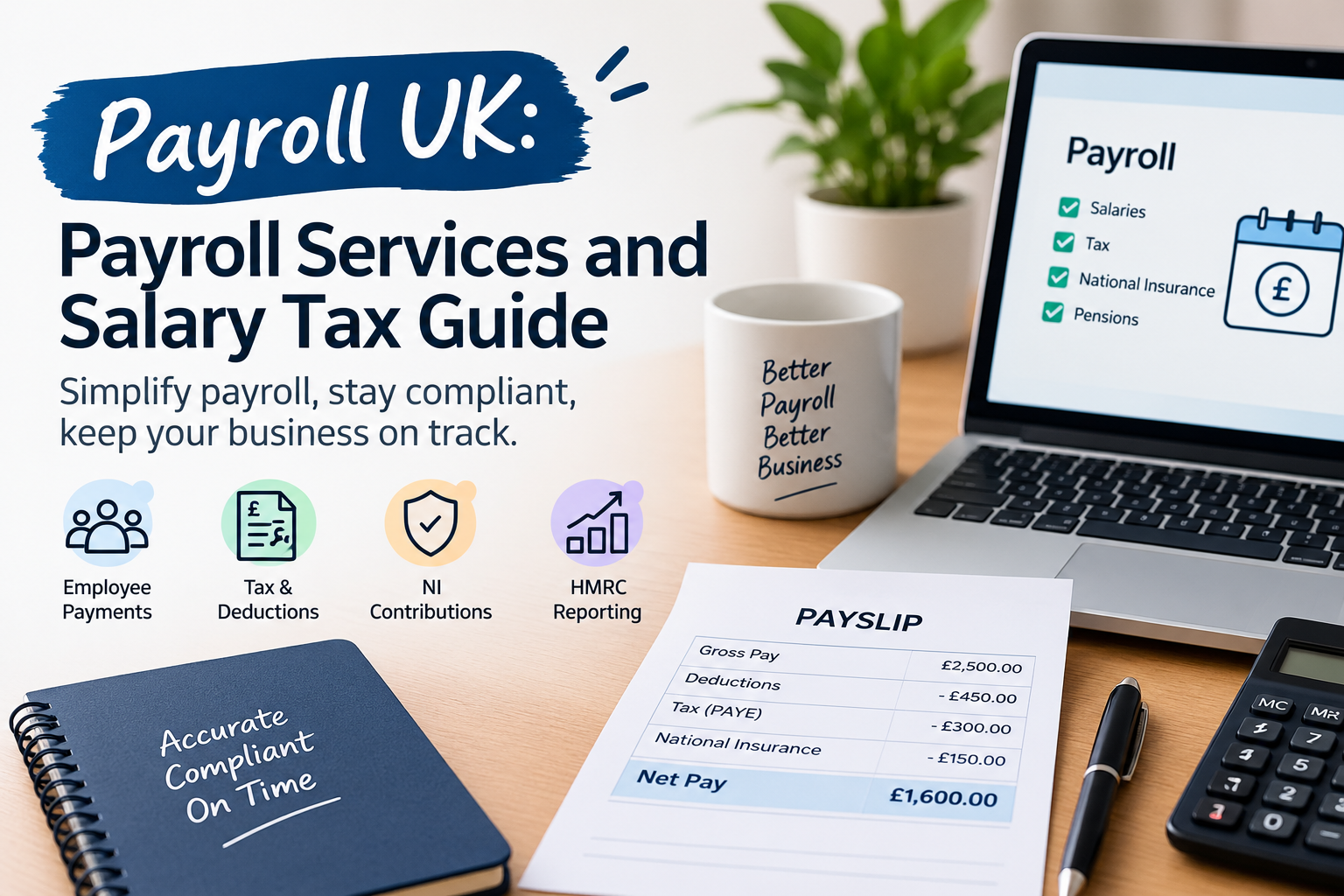
Payroll UK: Payroll Services and Salary Tax Guide
Payroll is a regular part of running a business, and it is important to get it right every time.
Employees expect to receive the correct pay on time. At the same time, businesses have to deal with tax, National Insurance and a range of other payroll responsibilities.
For a small business with just a few employees, payroll might not seem like a major task. As the business grows, however, things can become much harder to keep track of. Salaries, overtime, tax, deductions and reporting can all take more time than expected.
This guide looks at the main areas of payroll, including what payroll services usually cover, how payroll systems can make the process easier, and how UK salary tax and other deductions can affect an employee’s pay.
What Is Payroll?
Payroll is the process a business uses to work out how much an employee should be paid and then make sure they receive the right amount.
The starting point is gross pay. This might be a fixed monthly salary or wages based on the hours an employee has worked. Where applicable, overtime is included as well. Bonuses and commission may also form part of gross pay.
Once the gross amount has been worked out, the relevant deductions are calculated. The amount left after those deductions is what the employee receives as net pay.
In simple terms:
Gross Pay − Deductions = Net Pay
Payroll is not limited to calculating salaries. It also involves keeping payroll records, preparing payslips and, where required, reporting payroll information to HM Revenue & Customs (HMRC) and other relevant authorities.
How Does Payroll Work?
Although the details can vary from one business to another, a payroll run usually follows the same basic steps.
The first thing a business needs to do is check what has changed since the previous payroll. This could be a new employee joining the business, someone leaving, a change in salary, overtime, bonuses, sickness or holiday.
Once these changes have been checked, the payroll information is reviewed and the employee’s gross pay is calculated.
The relevant deductions are then worked out. Depending on the employee and their circumstances, these may include PAYE Income Tax, National Insurance, pension contributions and other applicable deductions.
After everything has been checked, the final amount due to the employee is calculated and payslips are prepared.
For businesses in the UK, payroll information also needs to be reported to HMRC through the PAYE system.
What Do Payroll Services Include?
Payroll services cover the regular work involved in paying employees and keeping payroll records properly maintained.
The exact service depends on the provider, but it may include:
- Calculating employee salaries and wages
- Calculating overtime and bonuses
- Calculating PAYE and National Insurance
- Preparing payslips
- Managing pension deductions
- Managing statutory payments
- Preparing reports
- Submitting required information to HMRC
- Maintaining payroll records
Not every business needs to outsource everything. Some choose to hand over the complete payroll process to an external provider, while others only get help with particular parts of payroll.
The most suitable approach will usually depend on the size of the business, the number of employees and how much of the payroll work the business wants to keep in-house.
Payroll Services UK
Businesses looking forpayroll services UK are often looking for a simpler way to manage their regular payroll work.
A payroll provider can deal with the routine calculations while keeping employee records and deductions organised. This can be useful for businesses that do not have someone specifically responsible for payroll.
For a small business in particular, outsourcing can also free up the owner’s time. Instead of spending hours dealing with payroll, they can focus on other parts of the business.
That does not mean every provider will offer the same service, though. It is important to check that the provider understands current UK payroll requirements and is clear about what is included.
Payroll Services for Small Business UK
Payroll can become more involved than a small business might expect.
Even when there are only a few employees, there can be different salaries, tax codes, pension contributions, overtime payments and leave to keep track of. Each of these needs to be recorded correctly.
This is wherepayroll services for small business UK can help.
A small business may use a payroll provider to deal with its regular monthly payroll, including payslips, PAYE, National Insurance, pension deductions and HMRC reporting.
Outsourcing the work does not mean the business has to lose control over payroll.
The business should still be able to review the payroll before it is finalised and have access to its payroll records.
Choosing a Payroll Company UK
There are plenty of choices when looking for apayroll company UK, so the cheapest monthly price is not necessarily the only thing worth considering.
Start by checking exactly what the provider includes in its service and how payroll changes need to be submitted.
It is also worth finding out who will deal with HMRC submissions and whether pension processing is part of the service.
There are some other practical questions to ask too. How is employee information kept secure? Can the provider cope as the business grows? And what kind of support is available if there is a problem?
A provider that is clear about its services and pricing can make the whole process of choosing a payroll company much easier.
Payroll Systems UK
Many businesses now use payroll software rather than working through every payroll calculation manually.
Modernpayroll systems UK can automate things such as salary calculations, tax and National Insurance deductions, payslips and payroll reports.
That can save time and cut down on the amount of repetitive work involved in each payroll run.
There is still an important point to remember, though. Payroll software depends on the information entered into it. If an employee’s salary or tax code is wrong, the software will use that incorrect information and the result can be wrong as well.
For that reason, payroll calculations should always be checked before the payroll is finalised.
Understanding UK Income Tax
If you are responsible for payroll in the UK, it helps to have a basic understanding ofUK income tax.
Employees generally pay Income Tax on their taxable earnings once their available Personal Allowance has been used. For the 2026/27 tax year, the standard Personal Allowance is £12,570 for most people. The Personal Allowance may be reduced where adjusted net income is more than £100,000.
The main Income Tax rates for England, Wales and Northern Ireland for 2026/27 are:
- Up to £37,700 20%
- £37,701 to £125,140 40%
- Above £125,140 45%
These figures apply after the relevant allowances have been taken into account. Scotland has separate Income Tax bands and rates, so Scottish taxpayers need to use the Scottish rates.
What Is the UK Income Tax Threshold?
When people search for theUK income tax threshold, they are often trying to understand how much they can earn before Income Tax starts to apply.
This is connected to the Personal Allowance, which for 2026/27 is a standard £12,570 for most people.
Someone who receives the full Personal Allowance can generally receive the first £12,570 of income tax-free. There are, however, exceptions depending on the individual’s circumstances.
For example, someone with a different tax code or income above the Personal Allowance taper may have a different tax position.
Salary Tax Bands UK Explained
Thesalary tax bands UK system works on a progressive basis, meaning that different tax rates apply to different portions of income.
This is worth understanding because moving into a higher tax band does not mean that the higher rate suddenly applies to the employee’s entire salary.
For instance, part of an employee’s salary may be taxed at 20%, while the portion that falls into the higher-rate band may be taxed at 40%.
As a result, looking at someone’s annual salary alone is not enough to work out exactly how much Income Tax they will owe. Allowances, deductions and other factors also have to be taken into account.
How Is UK Tax on Salary Calculated?
A simple example can make this easier to understand.
Suppose an employee in England earns£40,000 a year and receives the standard £12,570 Personal Allowance.
Their taxable income would be:
£40,000 − £12,570 = £27,430
If we keep the example simple and only look at Income Tax:
£27,430 × 20% = £5,486
So, the estimated Income Tax would be£5,486.
This is only a simplified calculation. In actual payroll, other factors can also come into play, including National Insurance, pension contributions, student loan repayments, benefits and the employee’s tax code.
Salary After Tax UK
When people search forsalary after tax UK, they are usually trying to answer a straightforward question: how much of their salary will they actually receive?
Income Tax is only part of the calculation. National Insurance and any other applicable deductions can also affect the final amount.
A simple way of looking at it is:
Gross Salary − Income Tax − National Insurance − Other Deductions = Net Salary
For example, someone earning £40,000 does not simply pay 20% tax on the entire salary.
Their Personal Allowance, the relevant tax bands, National Insurance and any other deductions all need to be considered when working out their take-home pay.
Salary calculators can therefore be useful for getting an estimate, but actual payroll should be calculated using the employee’s current information and the applicable tax rules.
National Insurance in Payroll
National Insurance is another important part of the payroll process.
For employees, National Insurance is normally taken from their pay through the PAYE payroll system. Employers may also have their own Employer National Insurance liability.
For the 2026/27 tax year, the standard employee Class 1 National Insurance rate is 8% on earnings between the Primary Threshold and Upper Earnings Limit, and 2% on earnings above the Upper Earnings Limit.
The calculation is not identical for every employee. National Insurance can depend on a number of factors, including the employee’s category letter and earnings.
Payslips: What Should Employees See?
A payslip gives an employee a breakdown of their pay and shows how the amount they have been paid has been worked out.
In the UK, employees and workers must receive a payslip on or before payday.
A payslip should include:
- Gross pay
- Income Tax
- National Insurance
- Other deductions
- Net pay
If an employee is paid according to the hours they work, the relevant hours should also be shown on the payslip.
Having a clear payslip makes it easier to see why an employee’s take-home pay is different from their gross salary.
Workplace Pension and Payroll
Workplace pensions can also be part of the payroll process.
Where pension duties apply, payroll may need to calculate both employee and employer contributions and deduct the employee’s contribution from their pay.
These deductions need to be checked because they affect the amount that ultimately reaches the employee’s bank account.
Overtime, Bonuses and Other Payments
Employees do not necessarily receive the same amount every month.
An employee might work overtime in one month, for example, or receive a bonus that is not included in their normal monthly pay.
These additional payments need to be entered correctly into payroll. They can increase gross pay and may also affect Income Tax and National Insurance deductions.
For this reason, payroll teams should check any changes to an employee’s pay before processing the payroll.
PAYE and HMRC Reporting
Employers operating PAYE in the UK also have reporting responsibilities to HMRC.
When employees are paid, employers generally need to submit aFull Payment Submission (FPS) to HMRC. This contains information about employee pay and deductions.
Depending on the circumstances, anEmployer Payment Summary (EPS) may also be required.
The information needs to be submitted correctly and on time. Keeping payroll records organised also makes it easier for a business to see what has been submitted and what has been paid.
Payroll Records
Good payroll management is about more than simply getting the figures right on payday.
Businesses also need to keep their payroll records up to date.
These records can include:
- Employee details
- Salary and wage information
- Tax codes
- Payroll calculations
- PAYE records
- National Insurance information
- Pension information
- Payroll reports
- Payments made to HMRC
HMRC generally requires employers to keep PAYE records for three years from the end of the tax year they relate to.
Other employment records can have different retention requirements, so businesses should make sure they understand the rules that apply to each type of record.
Manual Payroll or Payroll Software?
There is no single payroll method that will suit every business.
For a very small business, suitable software and a straightforward process may be enough to manage payroll.
As the business grows and the number of employees increases, dedicated payroll software or an external payroll provider may make more sense.
Payroll software can be useful because it automates repetitive calculations and reporting.
The important thing to remember is that the software still relies on the information entered into it. If that information is incorrect, the system can produce an incorrect result.
Common Payroll Mistakes
Payroll mistakes are not always caused by complicated calculations.
Sometimes, it is something much simpler: a small change has been overlooked.
Common payroll mistakes include:
- Using an old tax code
- Forgetting overtime
- Missing a bonus
- Entering incorrect employee details
- Applying the wrong National Insurance category
- Making incorrect pension deductions
- Missing an HMRC deadline
- Using outdated tax rates
- Issuing an incorrect payslip
A quick check before the payroll is finalised can help identify many of these problems before payments are made.
How Businesses Can Make Payroll Easier
Payroll does not have to be an unnecessarily complicated process.
One of the simplest things a business can do is keep employee records up to date and make sure any payroll changes are passed on before the payroll deadline.
It is also worth regularly checking:
- Salary changes
- Tax codes
- Deductions
- Payroll against accounting records
- Payroll reports
- Current tax-year rates
- Required submissions and deadlines
- Employee information security
For a growing business, outsourcing payroll or using a suitable payroll system can also take away a significant amount of routine administration.
Frequently Asked Questions
What is payroll?
Payroll is the process of calculating and managing employee pay, including deductions and net salary, as well as payslips, records and reports.
What are payroll services?
Payroll services help businesses manage tasks such as calculating salaries, PAYE, National Insurance, pensions, payslips and payroll reports.
What are payroll services for UK?
Payroll services for UK help employers manage UK payroll requirements, including employee pay, PAYE, National Insurance, payslips and reporting.
What is the UK income tax threshold for 2026/27?
The standard Personal Allowance for the 2026/27 tax year is £12,570. This means that people who receive the full allowance can normally receive £12,570 before Income Tax starts to apply.
What are the salary tax bands in the UK?
For 2026/27, the main Income Tax rates for England, Wales and Northern Ireland are 20%, 40% and 45%. Scotland has separate Income Tax bands and rates.
How do I calculate salary after tax in the UK?
Start with the employee’s gross salary and deduct the applicable Income Tax, National Insurance and any other deductions to arrive at their net salary.
Are payroll services useful for small businesses?
They can be, aspayroll services for small business UK can reduce administrative work and help businesses manage regular payroll calculations, payslips and reports.
Final Thoughts
Payroll can look like a simple monthly job, but there is actually quite a bit involved in making sure an employee is paid correctly.
There is the initial calculation of gross pay, followed by deductions, payslips and the required reporting. Each part needs to be handled carefully.
For businesses operating in the UK, understanding PAYE, UK income tax, National Insurance and salary tax bands is important. A suitable payroll system or payroll service can make the day-to-day process easier, but regular checks are still needed.
Whether a business manages payroll internally, uses payroll software or works with a payroll company, accurate information and the correct tax-year rules should remain a priority.
The UK tax information included in this guide relates to the 2026/27 tax year. Tax rates, thresholds and other payroll rules can change, so current HMRC guidance should always be checked before using this information for actual payroll calculations.
Need Help With Your Payroll?
Managing payroll accurately can take time, especially as your business grows. If you need support with payroll calculations, payslips, PAYE, National Insurance or regular payroll processing, professional payroll support can make the process easier.
Get in touch with us today to discuss your payroll requirements.
Get in Touch
Let’s Talk
📞 +44 742-1487-004
Email Us
✉️ info@ataaccountax.com
Author: Anees